


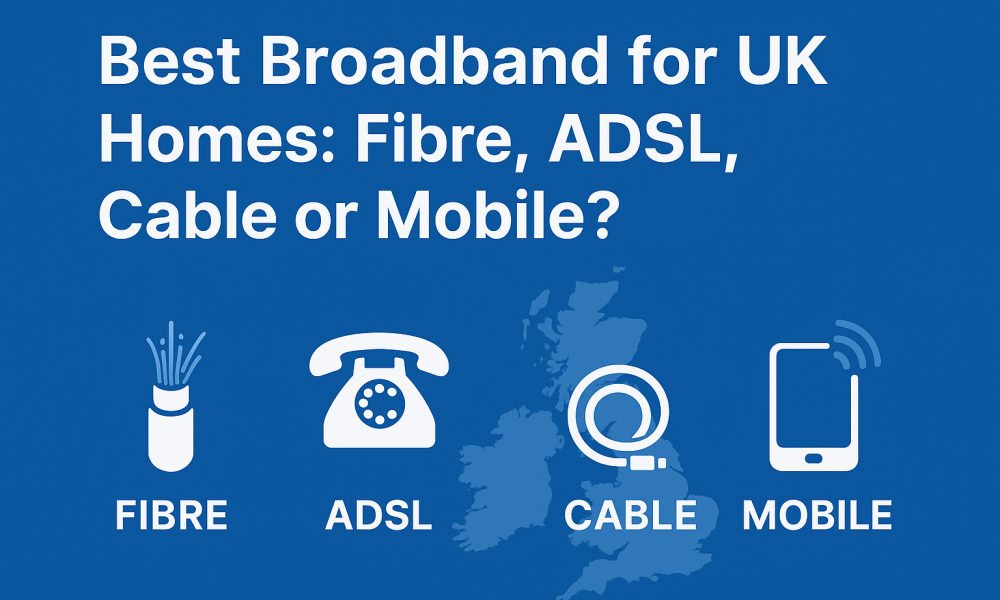

Choosing the right broadband connection for your UK home isn’t just about speed — it’s about reliability, cost, coverage, and future readiness. With options like ADSL, fibre (FTTC / FTTP), cable, and mobile broadband (4G / 5G), every household’s ideal solution can differ.
In this article, we’ll compare all these types across key factors, help you assess what fits your usage and situation, and guide you toward a confident decision for your home connection.
Understanding Broadband Types in the UK
What Is ADSL?
- ADSL (Asymmetric Digital Subscriber Line) uses existing copper telephone lines from your home to the telephone exchange.
- Typical download speeds: 10–20 Mbps, with much lower upload speeds.
- The further your home is from the exchange, and the poorer the line condition, the slower your actual speed.
- Pros: Widely available in areas with older infrastructure; typically cheaper.
- Cons: Lower speeds, unstable performance, high latency, and it’s being phased out.
- Important note: The UK plans to retire copper-based services (including ADSL) — the full copper / PSTN switch-off is scheduled for 31 January 2027 — meaning ADSL will not be viable in many places in the near future.
Fibre Broadband (FTTC vs FTTP / Full Fibre)
- FTTC (Fibre to the Cabinet): Fibre runs to a local street cabinet; from there, copper still connects to your home. This hybrid approach improves on pure copper, but performance degrades over the copper segment.
- In ideal circumstances, FTTC may deliver up to ~ 76 Mbps.
- FTTP / Full Fibre (Fibre to the Premises): Fibre runs all the way to your home — no copper involved. This yields better speeds, lower latency, and more dependable performance.
- Many providers now offer gigabit (1,000 Mbps) and higher plans via FTTP.
- Pros: High speeds, stable performance, future-proof.
- Cons: Availability is still rolling out, and there can be installation costs or delays in less served areas.
Cable Broadband
- Cable broadband uses hybrid technologies — fibre in backbone, coaxial cable (like the type used for TV) for the “last mile.”
- In many areas (especially where providers like Virgin Media / Virgin Media O2 operate), cable networks can deliver very high speeds (hundreds of Mbps, even gigabit in some cases).
- Pros: Strong option where fibre isn’t fully rolled out, good speed and stability in many urban / suburban settings.
- Cons: Not available everywhere, and performance can suffer during peak demand because of shared infrastructure.
Mobile Broadband (4G / 5G)
- Uses cellular networks (4G or 5G) with a router (MiFi), dongle, or via mobile-phone tethering.
- Speeds depend heavily on signal strength, network capacity, distance to cell towers, and network congestion.
- Pros: Useful in areas that lack wired infrastructure, portable, easier to set up, can serve as backup.
- Cons: Data limits / fair use policies, variable performance (especially indoors or in remote areas), higher latency in many cases.
How the Options Compare
Speed Comparison
Here’s a rough ranking in typical UK settings:
| Connection Type | Typical Speeds / Range | Notes |
|---|---|---|
| ADSL / copper | ~ 10–20 Mbps (download) | Upload is much lower |
| FTTC (hybrid fibre) | Up to ~ 76 Mbps in best cases | Performance depends on copper segment |
| Full Fibre (FTTP) | Hundreds of Mbps to 1 Gbps (and beyond) | Best consistency & latency |
| Cable | Hundreds of Mbps, some gigabit | Depends on provider and local network load |
| Mobile (5G) | Varies — in strong coverage can match wired speeds | Depends heavily on location, network load |
UK context & stats:
- As of mid-2025, full fibre availability in the UK has reached ~ 78–80% of premises. ThinkBroadband Labs+2thinkbroadband+2
- Gigabit-capable broadband is now accessible to ~ 86% of UK homes (via cable, full fibre, or other technologies) as reported by Ofcom. www.ofcom.org.uk
- Most UK users today see download speeds in the 60–280 Mbps range; the median tends to hover around 75 Mbps in many reports. Fair Internet Report
Reliability & Latency
- Full fibre (FTTP) offers the most stable, low-latency connection, less susceptible to interference or signal degradation.
- Cable is generally reliable, though performance can vary when many users use the network simultaneously (peak times).
- FTTC / hybrid fibre must still rely on copper for part of the line, which can introduce signal loss, interference, and increased latency.
- ADSL tends to have more variability, higher latency, and occasional line noise.
- Mobile broadband may suffer from congestion, signal fluctuations, and weaker indoor coverage — latency is generally higher compared to wired options.
Cost & Affordability
- ADSL / copper plans are often the cheapest, but diminishing in availability as providers phase them out.
- Mid-tier fibre / cable plans often offer excellent value for most households.
- High-speed fibre / gigabit plans command premium pricing.
- Mobile broadband pricing depends on data packages, contract terms, and network used. Heavy users can face steep costs under data caps or usage policies.
- Also consider one-time costs: setup, router, line installation, any upgrades needed (especially for full fibre).
Availability & Coverage
- Full fibre coverage is expanding quickly across the UK, but in many rural or remote areas, it is still catching up. Broadband Breakfast+3www.ofcom.org.uk+3www.ofcom.org.uk+3
- FTTC / hybrid fibre / copper is more widespread in areas not yet served by full fibre.
- ADSL / copper is still technically available in many places today but will be phased out as the switch-off approaches.
- Cable broadband is limited to regions where the ISP has laid coax / cable infrastructure.
- Mobile broadband has wide coverage in many places, but signal strength and indoor reliability can be limiting in remote or obstructed locations.
Which Connection Is Best for Your Home?
1. Identify Your Usage Profile
- Light user: Web browsing, email, standard definition streaming — you don’t need extreme speeds.
- Typical household / family: Multiple devices streaming HD, video calls, smart home use — you’ll benefit from a stable fibre or cable option.
- Power user / gamer / remote worker: Demanding tasks like 4K streaming, online gaming, large file uploads — full fibre (gigabit or higher) is strongly preferable.
2. Match with Your Local Situation
- If full fibre (FTTP) is available at your address → choose full fibre
- If not, but cable is offered in your area → consider cable as a strong alternative
- If neither full fibre nor cable is available → FTTC / hybrid fibre can serve as an interim choice
- In areas where wired options are limited → mobile broadband (5G / 4G) may be necessary, though with trade-offs
- Always be mindful of the upcoming copper switch-off (2027) — avoid relying on purely copper-based services long term
3. Quick Decision Checklist
- ✅ Full fibre available? Choose it.
- ✅ Cable available and fibre not offered? Evaluate cable.
- ✅ Neither fibre nor cable? Use FTTC or hybrid as a fallback.
- ✅ Wired options are poor? Use mobile broadband, but check data, signal, costs.
- ✅ Always run a postcode / address broadband availability check before committing.
- ✅ Plan for the future: avoid ADSL / copper-only services, since they’ll be retired.
Future Trends & What to Watch
- The UK is targeting 96% fibre coverage in the next two years. Broadband Breakfast+1
- Many areas are already shifting to “stop-sell” status for copper-based services (i.e. providers no longer begin new copper contracts).
- Cable networks are also evolving — upgrades (e.g., DOCSIS 3.1 / 4.0) may push cable speeds even higher.
- Mobile broadband (5G / future 6G) continues to improve — might become far more competitive with wired options, especially in under-served zones.
- Watch local provider rollouts, government infrastructure funding (e.g. Project Gigabit), and ISP plans in your area.
Conclusion
When it comes to the “best” broadband for your UK home, here’s the nutshell:
- Full fibre (FTTP) is the ideal — fast, reliable, future-proof.
- Cable is a strong fallback in many urban / suburban locations.
- FTTC / hybrid fibre may be viable for now, but has limitations.
- Mobile broadband is useful where wired options aren’t viable, but comes with trade-offs.
- ADSL / copper-only should be avoided as a long term choice, due to the planned switch-off.
Use the decision checklist above, check what’s available at your address, and pick the option that balances your usage, budget, and long-term needs.
Frequently Asked Questions
What is the difference between FTTC and FTTP?
FTTC (Fibre to the Cabinet) uses fibre to a street cabinet, then uses copper wiring from the cabinet to your home; FTTP (Full Fibre) runs fibre directly to your premises, offering better speed, reliability, and lower latency.
Will copper / ADSL connections be retired by 2027?
Yes — the UK plans to retire its copper / PSTN / analogue network by 31 January 2027, which means copper-based broadband (including ADSL) will be eliminated in many areas.
Is cable broadband faster than fibre?
Full fibre typically outperforms cable regarding consistency, upload speeds, and latency. Cable can deliver high speeds too, but performance may fluctuate more during peak hours.
Can mobile broadband replace fixed broadband at home?
In some cases, especially with solid 5G coverage, mobile broadband can work. But it may come with limitations: data caps, variable performance, weaker indoor signal, and higher latency. It’s often best as a backup or interim option.
How do I check what broadband types are available at my address?
Use broadband availability checkers provided by major ISPs (BT, Virgin, Openreach) or national / regional tools. Enter your postcode or full address to see which options you can order.

Other Articles