





A Post Office savings account gives people an easy way to save money. There are several options, including ISAs, bonds, and easy-access accounts.
You get flexibility, competitive interest rates, and the reassurance of saving with a well-known institution. It’s a solid pick for anyone who wants security and steady growth, honestly.

Most accounts let you manage your money online, so you can check your balance or move funds whenever you want. There are tax-free options like ISAs and fixed-rate bonds, so whether you want instant access or you’re thinking longer term, you’ll probably find something that fits.
The Post Office has loads of branches and solid online services. You can open or switch accounts without much hassle.
Clear rates and terms make it easier to figure out what you’ll earn and how to get the most from your savings.
Key Takeways
- Post Office savings accounts come with flexible, secure options.
- Interest rates change depending on the account, and some have tax perks.
- You can manage your savings easily, either online or in a branch.
Overview of Post Office Savings Accounts
The Post Office offers a bunch of savings accounts for people with different goals. Some suit short-term savers, others are better for the long haul.
You can earn interest while keeping your money accessible—or lock it away for a while if that’s your thing.
Key Features and Benefits
You get easy access accounts and fixed-rate bonds, depending on how much flexibility you want. Rates go up to 4.05% on certain accounts, but it depends on the type and term.
Some accounts let you withdraw money instantly, others need notice or have restrictions. They all come with the security of being managed with the Bank of Ireland.
You can manage your account online or in a branch. Some accounts allow regular deposits or withdrawals with no penalty.
Account Types Overview
Here are the main types of Post Office savings accounts:
- Instant Saver: Get your money out whenever you want, no restrictions.
- Fixed-Rate Bonds: Lock in a guaranteed rate for 1–3 years, no surprises.
- Reward Saver Notice Account: Need to give 30 days’ notice to withdraw, but you get a better rate.
- ISAs (Individual Savings Accounts): Save tax-free, with both Cash ISAs and fixed-rate options.
Each one fits a different goal, from weekly savings to locking away a lump sum for a few years.
How Post Office Savings Accounts Work
When you put money into a Post Office savings account, it starts earning interest. The rate depends on the account and what’s currently on offer.
You can open accounts online or at a branch, but you’ll need ID and some basic info. Some accounts let you take money out any time, while others lock your funds until maturity.
Interest usually gets paid annually or monthly. Fixed-term accounts won’t let you access your money early without a penalty, but easy access accounts are more flexible.
If you want to switch branches, you just need the right paperwork. It’s all pretty straightforward.
Types of Post Office Savings Accounts
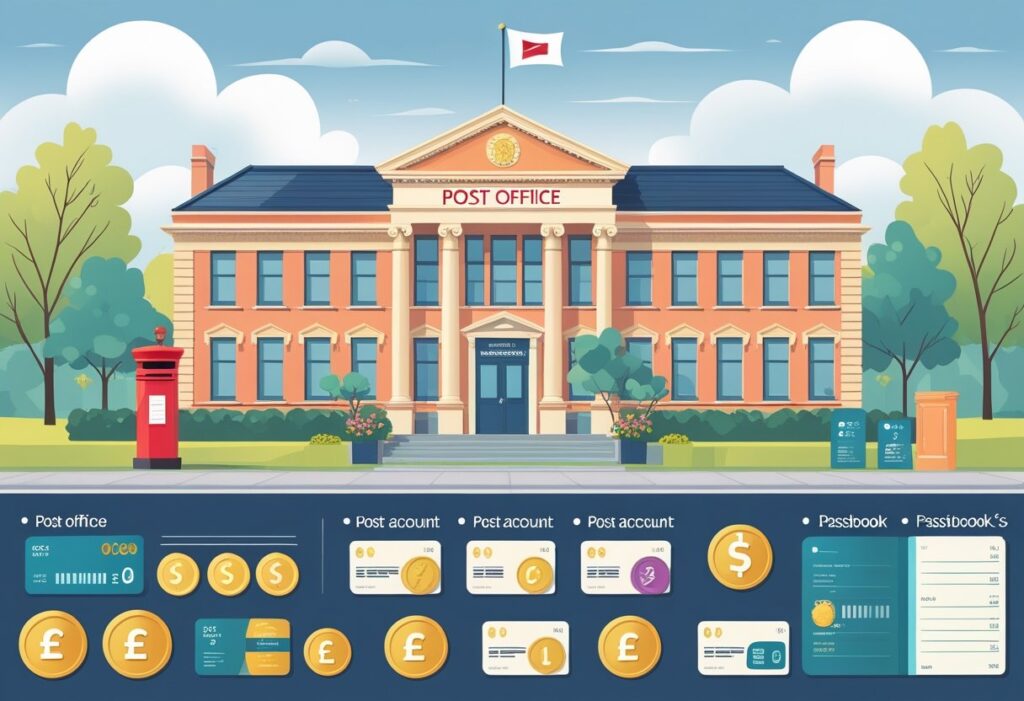
Post Office savings accounts come in a few shapes and sizes. Whether you want instant access or to lock your money away, there’s something for everyone.
Easy Access Savings Accounts
Easy access accounts let you take out your money whenever you need it, penalty-free. The Instant Saver Account and Online Saver Account are popular picks.
The interest rate can change, so it’s variable—not fixed. These accounts are great for emergency funds or if you just want to dip in and out.
Most people manage them online or in a branch. It’s just simple, no fuss.
Fixed Rate Savings Accounts
Fixed rate savings accounts—sometimes called fixed rate bonds or growth bonds—lock your interest rate for a set time, usually one to three years. The rate doesn’t budge during that period.
If you don’t need to touch your money and want a predictable return, this is the way to go. Just remember, you can’t take your cash out early without a penalty.
There’s usually a minimum deposit to get started.
Cash ISAs
Cash ISAs from the Post Office are tax-free, so you don’t pay tax on the interest you earn. You’ll find both easy access and fixed-term versions.
There’s a yearly limit on how much you can put in, set by the government. These are perfect if you want to save efficiently and avoid tax on your interest.
Notice Savings Accounts
With notice accounts, you have to give advance warning—usually 30 to 90 days—before you can withdraw your money. That’s how they can offer better rates than easy access accounts.
They sit somewhere between fixed and easy access accounts. If you want a higher rate but still need occasional access, this could work for you.
| Account Type | Access | Interest Type | Suitability |
|---|---|---|---|
| Easy Access Savings | Anytime withdrawal | Variable | Short-term and emergency funds |
| Fixed Rate Savings | Locked until term ends | Fixed | Long-term savers |
| Cash ISAs | Depends on ISA type | Tax-free (variable or fixed) | Tax-efficient saving |
| Notice Savings Accounts | After set notice period | Usually higher fixed/variable | Medium-term savers |
Interest Rates and Returns
Interest rates on Post Office savings accounts depend on the product and term. You’ll find both fixed and variable rates, and you can choose monthly or yearly interest payments.
It’s worth knowing how these rates work, especially the difference between standard and bonus rates.
How Interest Rates Work
Interest rates are what the bank pays you for keeping your money with them. You’ll usually see them listed as a percentage—either gross or AER.
Gross is the rate before tax. AER shows what you’d actually earn in a year, including compounding.
Compound interest means you earn interest on your interest. That’s how your savings can grow faster.
Rates can be fixed for a set time or variable, changing with the market.
Current Interest Rates
Right now, easy access accounts usually pay around 3.01% AER. Fixed rate bonds often offer more—like 3.96% for a two-year bond.
Rates change with the economy, so always double-check before you open an account. Some accounts offer a bonus rate for new customers or bigger deposits.
Interest Rate With and Without Bonus
Some accounts give you a bonus interest rate if you meet certain conditions, like leaving your money untouched for a year. The bonus bumps up your rate, but you need to stick to the rules.
If you skip the bonus, your rate is lower but you get more flexibility. It’s a trade-off—do you want to lock your money away for more, or keep it handy?
Annual and Monthly Interest Options
You can get your interest paid once a year or every month. Annual payments might give you a bit more due to compounding, but monthly payments are great if you want regular income.
Which one’s better? It really depends on how you like to manage your money.
Taxation and Allowances
The tax rules for Post Office savings accounts can get a bit confusing. Some accounts are tax-free, others aren’t.
Tax-Free Savings and ISAs
ISAs are tax-free, so you don’t pay anything on the interest. With a Cash ISA or Fixed Rate Cash ISA, you can save up to £20,000 in the 2025/26 tax year.
You can split this allowance across different ISAs, but you can’t go over the total. All the interest you earn is yours to keep.
Taking money out of an ISA doesn’t affect your allowance or tax status.
UK Income Tax on Savings
If your savings aren’t in an ISA, you might pay income tax on the interest. The Personal Savings Allowance lets basic rate taxpayers earn up to £1,000 interest tax-free. Higher rate taxpayers get £500.
Anything above these limits gets taxed at your usual rate. The Personal Allowance (currently £12,570) helps reduce your taxable income before savings interest comes into play.
If your interest goes over these limits, you need to declare it on your tax return.
Capital Gains Tax Implications
Cash ISAs don’t trigger capital gains tax because they only earn interest. If you invest in stocks or funds through the Post Office, and you make a profit, you could owe CGT.
For 2025/26, the annual CGT allowance is £6,000. Anything above that gets taxed.
Cash ISAs are exempt from CGT, so they’re a safe bet if you want to avoid extra tax on your savings.
Account Access and Management
You can get to your Post Office savings in a few different ways. Digital tools, branches, phone, and even ATMs all make it pretty flexible.
Linked accounts and withdrawals are easy to manage, depending on what works best for you.
Online and Mobile Banking
Online banking lets you check your balance, transfer money, and withdraw whenever you want. The Online Saver account is especially handy for this.
Mobile apps work much the same way, so you can manage your savings on the go. Just register on the website or app, and log in with your password or security code.
If you forget your login, you can reset it. Online banking is probably the quickest, most secure way to keep an eye on things.
In-Branch and Postal Services
Some people still prefer going into a branch, and that’s totally fine. You can deposit or withdraw cash, update your details, or just ask questions in person.
If you need to send in forms or payments, postal services cover that too. Staff can help with changes to your nominated account or anything else you’re unsure about.
Just remember to bring ID and your account details. It’s a good option if you don’t want to bank online.
ATM and Phone Access
You can use ATMs to withdraw from your nominated account, as long as it supports ATM transactions. Most savings accounts don’t come with a card, so you’ll need to link a current account.
Phone banking is also available, letting you check balances, move money, or flag any issues. You’ll need to verify your identity with account numbers and a PIN.
It’s handy if you can’t get online or make it to a branch.
Withdrawals and Linked Accounts
Withdrawals really depend on the type of savings account you have. Instant and easy-access accounts let you take out money whenever you want, whether that’s online or in person.
Every savings account connects to a nominated account where your withdrawn funds end up. You can change this nominated account through online banking or by reaching out to customer support.
Make sure you use valid bank details—otherwise, you might face annoying transaction delays. It’s a good idea to keep your nominated account info up to date so transfers go smoothly.
Account Eligibility and Opening Requirements
If you want to open a post office savings account in the UK, you’ll need to meet certain criteria. These include balances, residency, age, and a bit of paperwork.
Minimum and Maximum Balances
To get started, the minimum deposit is usually just £1. That’s a pretty low bar, making it simple for most folks to open an account.
Some accounts require you to keep a small minimum balance, often around £10 or so, to avoid going inactive.
Most post office savings accounts also cap how much you can stash away. The maximum balance usually sits somewhere between £15,000 and £85,000, depending on the account.
If you’re thinking of putting in a large sum, check the specific limits for your account. Going over could affect your interest or even your account status.
Residency and Age Criteria
You have to be a UK resident to open a post office savings account. This rule makes sure you’re actually living in the UK and can use postal banking services.
Proof of address is usually needed to confirm where you live.
Age requirements depend on the account. For most standard savings accounts, you need to be at least 16 years old.
There are options for younger savers, too. Kids’ accounts have different age thresholds and usually need a parent or guardian to help open them.
Documents Needed to Open an Account
You’ll need a few documents to open a post office savings account. These include:
- A valid photo ID (like your passport or driver’s licence)
- Proof of address (utility bill, bank statement, or council tax bill)
- Sometimes, a National Insurance number or proof of age
This is all part of the Know Your Customer (KYC) process. It helps fight fraud and keeps everything above board.
You can open some accounts in person at the post office. Others let you apply online, but you’ll need to upload scanned documents.
Security and Regulation
Post Office savings accounts aim to keep your money safe. They follow strict rules set by regulators and protection schemes.
FSCS Protection and Safeguards
Money in Post Office savings accounts comes with FSCS protection. If something goes wrong with the institution, the Financial Services Compensation Scheme covers up to £85,000 per person, per institution.
Most Post Office savings products use Bank of Ireland UK plc to hold your funds. So, that FSCS protection applies here too.
Keep in mind, the £85,000 limit covers all your accounts with Bank of Ireland UK and linked providers, not just the Post Office. If you have several accounts, your combined balance is protected up to that limit.
Providers and Regulatory Bodies
Providers like Bank of Ireland UK plc, OneFamily, Family Assurance Friendly Society Limited, and Family Equity Plan Limited offer Post Office savings accounts. Each one falls under UK regulation.
The Financial Conduct Authority (FCA) keeps an eye on consumer protection, making sure companies play fair. The Prudential Regulation Authority (PRA) checks that these institutions stay financially healthy and have enough capital to protect your money.
Some building societies also offer savings accounts through the Post Office. They face the same FCA and PRA rules, so the protection’s consistent.
Comparing Post Office with Other Savings Options
Post Office savings accounts come with different terms and rates. But how do they stack up against banks, building societies, and other UK savings options?
Comparison with Banks and Building Societies
Post Office accounts usually offer competitive interest rates. Sometimes, though, banks or building societies—like Tesco Bank—might beat them with higher fixed rates or bonuses.
One thing the Post Office does have: more branches than any UK bank. That means you can deposit or withdraw cash in person just about anywhere.
Most banks and building societies focus more on online or telephone service, especially for savings.
Banks and building societies might also have more specialised products, like Help to Buy ISAs or Lifetime ISAs. The Post Office doesn’t always cover those.
Alternative Savings Accounts in the UK
Besides the Post Office, you’ve got options like fixed-rate bonds, easy-access accounts, and ISAs from banks like Tesco, NatWest, Halifax, and building societies such as Nationwide.
Easy-access accounts offer lower rates but let you withdraw money whenever you want. Fixed-rate bonds tie your money up for a while, but you usually get a better rate.
ISAs give you tax-free interest, which is nice if you’re saving long term. The Post Office does offer cash ISAs, but sometimes you’ll find better rates elsewhere. It pays to shop around.
Advantages and Disadvantages
Advantages:
- Loads of branches for face-to-face service
- Plenty of savings products, from instant access to fixed rate
- Simple application, whether you’re online or in-branch
Disadvantages:
- Interest rates might not be the best out there
- Not as many niche or specialised accounts as some competitors
- Online saver accounts sometimes lack features like withdrawal bonuses
If you like popping into a branch and want a straightforward account, the Post Office could work well. But if you’re chasing the top rates or something more specialised, you might want to look elsewhere.
Frequently Asked Questions
People often wonder how to open a Post Office savings account, what types are available, and how to manage them. Interest rates, online access, and the paperwork needed come up a lot too.
How can I open a savings account with the Post Office?
You can open a savings account by visiting a Post Office branch or using their online banking. If you’re already a customer, you can add more accounts through your online profile.
What are the current interest rates for Post Office savings accounts?
Interest rates change depending on the account. They’re always shifting, so check the Post Office website or ask at a branch for the latest.
What types of savings accounts are available at the Post Office?
The Post Office offers ISAs, easy access accounts, bonds, and online saver accounts. Each comes with its own terms for access and interest.
How do I access my Post Office savings account online?
Just log in to Post Office online banking. You can check your balance, withdraw funds, and handle your account 24/7 after linking a nominated UK current account.
Can I open a Post Office savings account without visiting a branch?
Yes, you can. Many accounts are available entirely online, as long as you have a UK current account. Occasionally, your first deposit might take a few business days to clear.
What documentation is required to set up a savings account with the Post Office?
You’ll usually need to show proof of identity and proof of address.
They also ask for a linked UK current account in your name for deposits and withdrawals.