



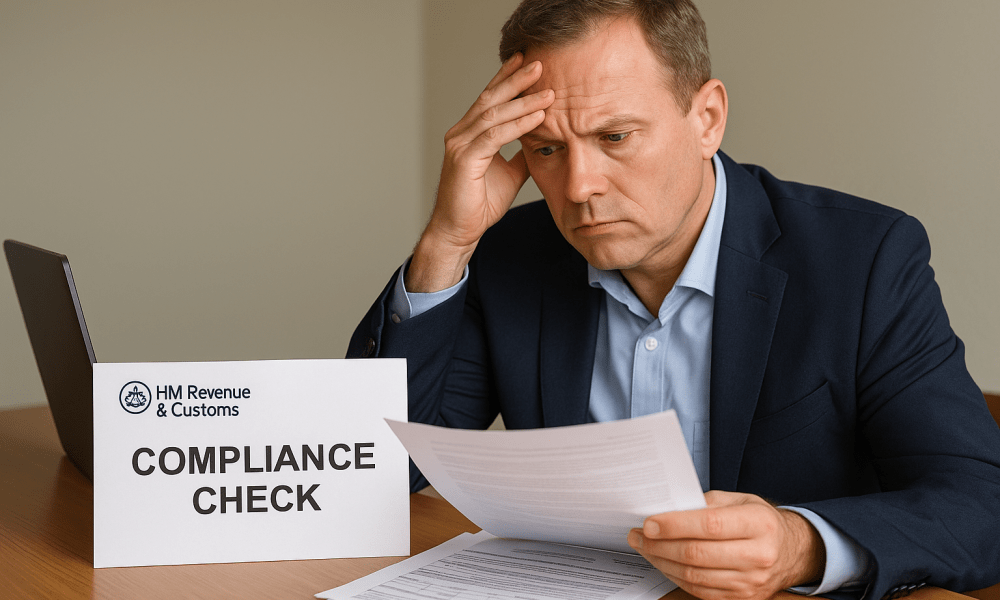
How to Handle an HMRC Compliance Check: Stages, Rights and Time Limits

HMRC opens a compliance check by writing or phoning to ask for information. Its factsheet CC/FS1a says you can appoint a representative, should tell the officer if you need more time, and must keep sending returns and payments that fall due. You cannot ignore a formal notice. You usually have 30 days to appeal a decision.
Tax year 2026/27. Last reviewed 27 October 2026.
Sources are HMRC’s own factsheets on GOV.UK, read on 27 October 2026. For penalties and Making Tax Digital, see our HMRC rules and compliance guide.
What is an HMRC compliance check?
A compliance check is HMRC looking at your tax position to make sure you are paying the right amount of tax at the right time and getting the right allowances and reliefs (CC/FS1a).
GOV.UK’s help page describes three steps: HMRC writes and asks for information, discusses your tax position with you, then works out the correct position and closes the check.
What happens at each stage of a check?
| Stage | What HMRC does | What you can do |
|---|---|---|
| Opening | Tells you what it needs, by letter or phone. | Read it, note the dates, and ask the officer if anything is unclear. |
| Information | May ask for information or documents. | Send what you can. Tell the officer early if you need more time. |
| Meeting or visit | May ask for a meeting, or to visit your business premises. | A meeting is your choice. A visit is normally agreed. |
| Finding | If something is wrong, explains why and works with you to put it right. | Tell the officer what you know and help work out the tax. |
| Close | Sends decision notices, or agrees a contract settlement. | Pay, or tell the officer if you cannot. Appeal if you disagree. |
What must you provide, and what if you do not?
HMRC normally asks first. If you do not provide what it needs, it can give you an information notice, which is a legal document. The CC/FS2 factsheet says the notice tells you what is needed, how and when to provide it, and what to do if you disagree. HMRC can only ask for things it believes are relevant and reasonable.
If you do not comply by the deadline, CC/FS2 says HMRC may charge a £300 penalty. Daily penalties of up to £60 a day can follow, and then a penalty based on the tax HMRC believes you owe, which the tax tribunal must authorise. There is no penalty if you have a reasonable excuse, such as serious illness or a close bereavement.
Do you have to attend a meeting or allow a visit?
A meeting is your choice, according to CC/FS1a. A visit works differently. The CC/FS3 factsheet says HMRC normally visits with your agreement and usually gives at least 7 days’ notice. Without agreement it may give a notice of inspection, which you cannot ignore. If you refuse, HMRC may ask the tax tribunal to approve it, and a refusal after that brings a £300 penalty plus up to £60 a day.
What are your rights during a check?
- You can appoint anyone to act for you (CC/FS1a). You still have to take reasonable care that anything sent on your behalf is correct.
- You can ask for extra support if health or personal circumstances make dealing with HMRC hard (GOV.UK).
- You can ask why something is needed, or say a request is unreasonable or not relevant.
- If HMRC is considering a penalty, CC/FS7A says you have the right not to answer its questions about it, though your help affects the size of any penalty.
How are penalties worked out if something is wrong?
The CC/FS7A factsheet sets out a penalty for an inaccuracy in a return that leaves tax unpaid, understated or over-claimed. There is no penalty if you took reasonable care. Otherwise it is a percentage of the extra tax, set by your behaviour and by whether you told HMRC before it found the problem.
| Behaviour | Told HMRC first (unprompted) | Told HMRC after it found it (prompted) |
|---|---|---|
| Reasonable care | No penalty | No penalty |
| Careless | 0% to 30% | 15% to 30% |
| Deliberate | 20% to 70% | 35% to 70% |
| Deliberate and concealed | 30% to 100% | 50% to 100% |
Within the range, the quality of your disclosure moves the percentage down. HMRC calls this telling, helping and giving, and allows up to 30% for telling, up to 40% for helping and up to 30% for giving access to records. If disclosure takes a long time, for example 3 years or more, HMRC usually restricts the reduction.
Take a careless error found by HMRC (prompted) where the extra tax is £4,000. The range is 15% to 30%. With no reduction for disclosure the penalty is 30%, or £1,200. With a full reduction it is 15%, or £600. These are our assumptions to show the method, not a forecast of any case.
How far back can HMRC look?
Separate time limits apply to enquiries and to assessments. For a personal Self Assessment return sent on or before the filing date, section 9A of the Taxes Management Act 1970 lets HMRC open an enquiry by giving notice within 12 months of the day you sent it. A late or amended return has a slightly longer window.
For an assessment of Income Tax or Capital Gains Tax, section 34 gives an ordinary limit of 4 years after the end of the tax year. Section 36 extends it to 6 years where the loss of tax was brought about carelessly and 20 years where it was brought about deliberately. Other taxes and companies have their own rules.
GOV.UK says Self Assessment records must be kept for at least 5 years after the 31 January submission deadline of the relevant tax year.
What happens at the end of the check?
HMRC either sends one or more decision notices (an assessment or amendment, a penalty notice, or a letter explaining the final position) or agrees a contract settlement (CC/FS1a). A contract settlement is a legally binding deal: you offer to pay everything you owe and HMRC agrees not to use its formal powers to recover it. It needs both sides to agree.
If you owe more tax, interest runs on it. GOV.UK gives the late payment interest rate as 7.75% from 9 January 2026, set at Bank of England base rate plus 4%. That is the rate as at 27 October 2026, and it moves with the base rate.
What if you disagree with HMRC’s decision?
HMRC’s decision letter tells you what you can appeal against. GOV.UK says you usually have 30 days from the date of the letter to appeal or accept a review. CC/FS1a lists the usual options: send new information, ask for a review by an HMRC officer not involved so far, or go to an independent tribunal.
You may also be able to ask for Alternative Dispute Resolution, where a trained HMRC officer acts as a neutral mediator. CC/FS21 says it is not a statutory process and HMRC can reject unsuitable applications.
Frequently asked questions
What if I cannot meet HMRC’s deadline?
Tell the officer before the date passes. CC/FS1a says HMRC may agree extra time if there is a good reason, such as serious illness or a close bereavement. If a formal information notice is ignored, CC/FS2 says HMRC may charge a £300 penalty, then daily penalties of up to £60 a day.
Can I refuse an HMRC visit?
HMRC’s CC/FS1a says visits are normally agreed with you first, and you cannot choose to ignore a notice of inspection. If you refuse one, CC/FS3 says HMRC may ask the tax tribunal to approve it. After approval, refusing brings a £300 penalty and up to £60 a day unless you have a reasonable excuse.
How long do I have to appeal an HMRC decision?
GOV.UK says you usually have 30 days from the date of the decision letter to appeal or accept a review. The letter explains what to do. If you miss the deadline you need to give a reasonable excuse. A penalty appeal is also usually 30 days from the date the penalty was issued.
Will HMRC charge a penalty if my return was wrong?
Not always. CC/FS7A says there is no penalty if you took reasonable care but the return was still wrong. A penalty can apply if the error was careless, deliberate, or deliberate and concealed. The percentage depends on the behaviour, whether you told HMRC before it found the error, and how much you helped.
Related reading
- HMRC rules and compliance
- UK gambling tax: what is and is not taxable
- Capital Gains Tax on UK property and using a CGT calculator
- Bank Rate and savings account rates
- GOV.UK: About compliance checks, CC/FS1a
This page is general information about UK tax and ISA rules. It is not financial, tax or investment advice. Rules and limits can change, so check the linked GOV.UK pages before you act, and consider speaking to a qualified adviser about your own circumstances.

Other Articles

HMRC Penalties and Interest in 2026/27: Worked Examples
How to Choose an Online Savings Account in the UK