




Transferring Cash ISA to Stocks and Shares Explained: A Clear Guide for Investors

Quick Answer for 2026:
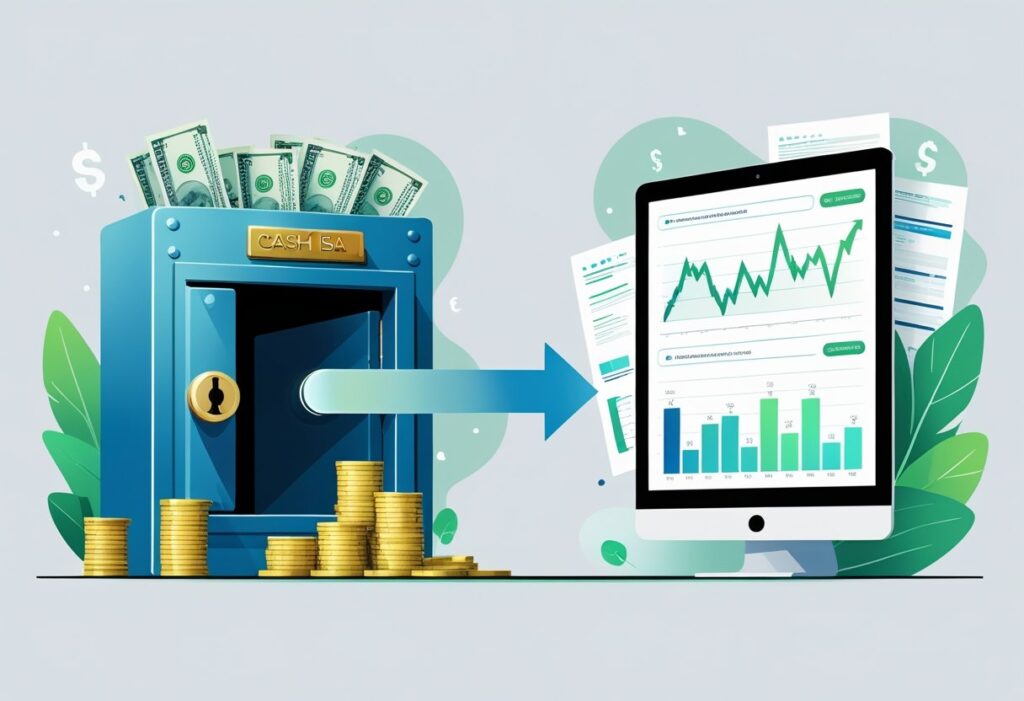
- Can I transfer a Cash ISA to a Stocks and Shares ISA? Yes. You can transfer previous and current year Cash ISA funds into a Stocks and Shares ISA without losing your tax-free wrapper, provided you use the official transfer process.
- How long does it take? A transfer from a Cash ISA to a Stocks and Shares ISA typically takes up to 15 to 30 calendar days.
- Will it affect my £20,000 allowance? No. As long as your new provider handles the transfer, moving past years’ savings does not consume your current 2025/2026 ISA allowance.
- Urgent 2026 Update: Under new rules, you can now make partial transfers of your current-year subscriptions. Furthermore, with the Chancellor announcing a reduction of the Cash ISA limit to £12,000 for under-65s starting in April 2027, transferring to a Stocks and Shares ISA is becoming a strategic priority for many savers looking to maximize their overall £20,000 allowance.
1. Understanding Cash ISAs vs. Stocks and Shares ISAs
When navigating the world of ISAs Explained, the first step is understanding the fundamental mechanics of the vehicles you are moving between. Both accounts offer a legally protected, tax-free wrapper shielding your money from the taxman, but their internal engines run completely differently.

The Cash ISA: Safety at the Cost of Growth
A Cash ISA operates exactly like a traditional bank savings account. You deposit your funds, and the bank pays you a set interest rate over time.
- The Primary Benefit: Absolute capital security. The exact numeric amount you put in will never decrease (unless you withdraw it). Furthermore, under the Financial Services Compensation Scheme (FSCS), up to £85,000 is protected per banking institution.
- The Hidden Risk: Inflation. While your nominal capital is safe, the purchasing power of that cash is constantly being eroded. If inflation sits at 4% and your Cash ISA pays 3%, you are actively losing wealth in real terms.
The Stocks and Shares ISA: Risk Meeting Reward
A Stocks and Shares ISA (often called an Investment ISA) uses your money to buy assets in the global financial markets. You can invest in individual company shares, corporate and government bonds, Exchange Traded Funds (ETFs), or managed mutual funds.
- The Primary Benefit: The potential for compound, market-beating growth. Historically, stock markets outpace both inflation and cash interest rates over long periods (typically a minimum of 5 to 10 years). Additionally, all dividends received and profits made from selling your assets are completely shielded from Capital Gains Tax.
- The Primary Risk: Capital volatility. The value of your investments can drop as well as rise. If the stock market experiences a downturn, the actual value of your ISA could fall below the total amount you originally invested.
2. Why Transfer from a Cash ISA to a Stocks and Shares ISA Now?
Deciding to move your capital from cash to the markets is a significant financial milestone. It represents a shift from a “saving” mindset to an “investing” mindset. But why are so many UK residents making this exact transfer in 2026?
Escaping the Inflation Trap
Over the past several years, the cost of living has starkly highlighted the weakness of holding too much cash. While having an emergency fund in a Cash ISA is highly recommended, hoarding long-term wealth in cash guarantees diminished spending power. By transferring excess cash to the stock market, investors give their money the opportunity to grow faster than the rate of inflation.
The Looming 2027 Cash ISA Cap (Crucial Update)
Following the Autumn Budget 2025, a massive shift in ISA legislation is approaching. Starting April 6, 2027, the Cash ISA allowance for individuals under the age of 65 will be capped at £12,000 per year. While the overall ISA allowance will remain at £20,000, savers will no longer be able to dump their full allowance into cash unless they fall under the Over-60s ISA & Retirement Savings demographic (specifically those 65 and older). Transferring funds to a Stocks and Shares ISA now allows savers to familiarize themselves with investment platforms before the new restrictions force their hand.
Total Protection from HMRC
Outside of an ISA, earning money through the stock market subjects you to the scrutiny of HMRC Rules & Compliance. You would be liable for taxes on dividends and capital gains. By transferring your cash directly into a Stocks and Shares ISA, you ensure that every penny of future growth remains legally outside of HMRC’s reach.
3. The Golden Rule of ISA Transfers
Before looking at the step-by-step process, you must understand the single most important rule of moving ISA funds:
Never, under any circumstances, withdraw the money to your personal bank account to move it yourself.
If you manually withdraw £15,000 from a Cash ISA and deposit it into a new Stocks and Shares ISA, that money loses its historical tax-free status. It will immediately consume £15,000 of your current £20,000 annual allowance.
To keep your tax-free wrapper intact, the transfer must be conducted electronically between the financial institutions.
4. How to Transfer Your ISA: A Step-by-Step Guide
Transferring your funds is a heavily regulated, streamlined process designed to protect the consumer. Here is exactly how to execute the switch in 2026.
Step 1: Research and Select Your New Provider
Not all investment platforms are created equal. You need to choose a Stocks and Shares ISA provider that aligns with your financial goals, technical comfort level, and budget. (We cover how to choose a provider in section 6).
Step 2: Open Your Stocks and Shares ISA
Go to your chosen provider’s website and open a new Stocks and Shares ISA. During the application process, you will be asked for your National Insurance (NI) number, which became a mandatory requirement for all new applications as of April 2025.
Step 3: Complete the Transfer Authority Form
During the setup of your new account, you will be asked, “Do you want to transfer an existing ISA?” Select yes. You will need to provide:
- The name of your current Cash ISA provider (e.g., Barclays, Monzo, Nationwide).
- Your current Cash ISA account number and sort code.
- Whether you want to transfer the full balance or make a partial transfer.
Step 4: Let the Providers Do the Work
Once you submit the electronic transfer form, your job is done. Your new investment platform will contact your old bank, request the funds, and ensure the tax-free wrapper remains perfectly intact during the transit.
Step 5: Choose Your Investments
Once the cash arrives in your new Stocks and Shares ISA, it will sit as “uninvested cash.” It is now up to you to buy funds, ETFs, or shares based on your risk appetite.
5. ISA Transfer Rules, Limits, and Allowances for 2025/2026
To avoid accidental penalties, you must understand how your transfer interacts with UK ISA Allowances & Rules.
The £20,000 Annual Allowance
For the 2025/2026 tax year, every UK adult has an overall ISA allowance of £20,000. This is the maximum amount of new money you can shelter from tax between April 6, 2025, and April 5, 2026.
Transferring funds from previous tax years does not count toward your current year’s allowance. If you built up £50,000 in a Cash ISA over the last five years, you can transfer the entire £50,000 into a Stocks and Shares ISA today, and you will still have your full £20,000 allowance available to use before April 5.
Partial Transfers Allowed (The 2024/2026 Update)
Historically, if you wanted to transfer money that you deposited in the current tax year, you had to move 100% of it.
Thanks to rule changes implemented in April 2024, you can now make partial transfers of current-year subscriptions. This gives you ultimate flexibility. If you deposited £10,000 into a Cash ISA in January, you can choose to transfer just £5,000 of it into a Stocks and Shares ISA in March, keeping the rest in cash.
Multiple ISAs of the Same Type
Another recent reform means you can now pay into multiple ISAs of the same type in a single tax year. You could technically pay into two different Cash ISAs and one Stocks and Shares ISA simultaneously, provided the total combined deposits do not exceed the £20,000 ceiling.
6. Understanding Fees, Charges, and Costs
Unlike Cash ISAs, which are entirely free to hold, Stocks and Shares ISAs cost money to operate. Failing to understand these fees can severely drag down your long-term returns. When moving to the market, you will encounter three main layers of costs.
1. Platform Fees (Account Management)
This is the fee the provider charges you simply for using their software and holding your money securely.
- Fixed Fee: A flat rate (e.g., £10 a month) regardless of how much money you have. Best for large portfolios.
- Percentage Fee: A percentage of your total holdings (e.g., 0.25% or 0.45% per year). Best for beginners with smaller portfolios.
2. Fund Management Charges (OCF/TER)
If you buy a managed mutual fund or an ETF, the people running that fund will take a cut. This is known as the Ongoing Charges Figure (OCF). This is automatically deducted from the fund’s performance and usually ranges from 0.05% for passive index trackers to over 1.00% for actively managed specialist funds.
3. Trading Fees (Dealing Charges)
Some platforms charge you every time you click “buy” or “sell.” If a platform charges £10 per trade, and you buy shares in five different companies every month, you will bleed £50 a month just in trading costs. Look for platforms that offer free regular investing or zero-commission trading if you plan to be highly active.
Fee Comparison Benchmark Table
| Fee Type | Cash ISA Average Cost | Stocks & Shares ISA Average Cost |
| Platform / Admin Fee | £0 | 0.15% – 0.45% per year |
| Fund Management (OCF) | N/A | 0.05% – 1.00%+ per year |
| Trading / Dealing Fee | N/A | £0 to £11.95 per trade |
| Transfer Out / Exit Fee | £0 | Usually £0 (but check terms) |
7. How to Choose the Right Stocks and Shares ISA Provider
With dozens of apps and legacy brokers vying for your capital, selecting the right home for your transferred funds requires careful consideration.
FSCS Protection and FCA Regulation
Security is paramount. Ensure your chosen provider is fully authorized by the Financial Conduct Authority (FCA). Furthermore, verify that they are covered by the Financial Services Compensation Scheme (FSCS). This ensures that if the brokerage itself goes bankrupt, your assets are protected up to £85,000.
Range of Investment Options
Are you a hands-on investor who wants to pick individual stocks like Apple or Tesla? Or do you want a “robo-advisor” that asks you a few risk-tolerance questions and builds a ready-made portfolio for you?
- DIY Platforms: Offer thousands of global shares, ETFs, and bonds. Best for those who want total control.
- Robo-Advisors/Ready-Made: Offer a small handful of pre-built risk profiles (Cautious, Balanced, Adventurous). Best for beginners who want a “set and forget” approach.
User Experience and App Functionality
If you are moving away from the simplicity of a Cash ISA, you want an interface that doesn’t overwhelm you. Look for providers that offer clean mobile apps, robust customer service (phone and live chat), and educational resources to help you understand market movements.

8. Frequently Asked Questions (FAQ)
How long does a Cash ISA to Stocks and Shares ISA transfer take?
Officially, providers have up to 30 calendar days to complete a transfer to a Stocks and Shares ISA. However, cash-to-shares transfers are often completed much faster, typically within 10 to 15 working days. Delays usually only occur if there are discrepancies in your paperwork, such as mismatched National Insurance numbers or old home addresses on file.
Is there a penalty for transferring my ISA?
Generally, no. The vast majority of modern ISA providers do not charge exit fees or transfer-out penalties. However, if your Cash ISA is a “Fixed-Rate” account (where you committed to locking your money away for 1, 2, or 5 years in exchange for a higher interest rate), transferring before the fixed term ends will usually trigger an early exit penalty. This penalty often equates to a loss of 90 to 180 days’ worth of interest.
Do I have to pay tax on the transfer?
Absolutely not. The entire purpose of the formal ISA transfer process is to maintain your tax-free wrapper. Because the money moves directly between the financial institutions, it never touches your taxable estate. You will face zero income tax, zero UK Tax penalties, and zero capital gains liabilities during the switch.
Can I transfer my Stocks and Shares ISA back to a Cash ISA later?
Currently, yes, but this will change in 2027. Right now, you can freely transfer wealth back to a Cash ISA if you decide the stock market is too risky. However, under the impending April 2027 rules, the government will ban transfers from Stocks and Shares ISAs into Cash ISAs for individuals under 65, in order to prevent circumvention of the new £12,000 cash cap.
What is the best time of year to transfer my ISA?
Financially, the best time is simply when you are ready to invest. However, from a logistical standpoint, it is highly recommended to initiate transfers well before the end of the tax year (April 5). If you initiate a transfer on April 3rd, the administrative backlog at most brokerages means it may not complete in time, potentially causing confusion regarding which tax year’s allowance is being utilized.